Windows of tolerance: understanding our emotional tolerances
The concept of windows of tolerance was originally proposed by Dr Dan Siegel to help explain trauma and stress responses in relation to someones optimal emotional state. While it is an extremely good, and, more importantly, useful model, we have also come to find it useful in a more general context. So what is the window of tolerance? The window of tolerance is the emotional range between hyperarousal (think fight or flight etc.) and hypoarousal (dissociation or numbness etc.), in which we are in an optimal emotional state. The optimal state is one of relative calm, where we are able to think clearly and act rationally.
A hyperaroused state is the region of emotions often associated irritability, heightened alertness and adrenaline. These are the "high emotion" trauma responses such as fight, flight and some forms of fawning, where emotions feel like a high energy rush, pushing you to action. In a hyperaroused state, you are more likely to lash out and take rash action, compared to when you are at your baseline. As a result, these states often lead to impulsive and aggressive decisions. Hypoarousaed states by contrast are defined by low-energy emotional responses, often numbness, disconnection and isolation from others. These states regularly result in various forms of dissociation. Hypoaroused states are often associated with "low emotion" trauma responses, such as freeze, flop and emotional dissociation, as well as some forms of fawning. In hypoaroused states, you are less likely to take action, and instead try to avoid decision making at all and often become withdrawn.
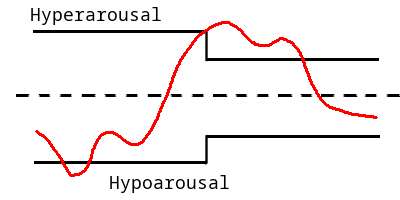
We can think of the window of tolerance as a graph of emotion over time, with the x-axis as the baseline emotional state. Over time our emotions will rise and fall relative to the x-axis, as different events cause our emotional state to change. While the x-axis might be our absolute baseline, we are rarely ever in this state. Instead the window of tolerance is range of values which our emotions are still under control or "optimal" (comments on the idea that under control is optimal can be left for another time), or, how far from the x-axis we can get before we end up in a hyper or hypoaroused state.
Using the window
So now we understand what these words all mean, what can we do with these things? Most of us who have been living with trauma are usually aware of these states, even if we haven't had a name for them until now. By developing our understanding of these states in ourselves, we can move from recognising them in hindsight, to recognising them in the moment. Like with many things, having a framework for processing and explaining these states, allows us to solidify our understanding of them. This is where the window of tolerance comes into play. It provides a structured framework to help us understand how our emotions are changing over time, and that these states don't just arise at random. Instead we can track our emotional progress on our little tolerance graph. We can understand that as things happen, our emotions respond until we cross out of the window of tolerance, either snaping or shuting down. Often we are taught that emotions are spontaneous result of an event. All of us, however, are fully aware this is not the case, and multiple events can stack together until something small, finally, pushes us over that line. We can now follow that progress easily on our plot.
There is one other way the window of tolerance lets us explain our emotional responses. Until now we have considered our emotions with respect to the width of the window, but we haven't considered that width itself. Have a think about your emotional states, notice how on a bad day, if your stressed about something or just tired, you tend to be able to tolerate less then on a well rested and good day. This is because the width of our window of tolerance is not fixed. Instead it is always shifting, in response to our environment and situation, even straying outside the window can cause the window to shrink. This often makes it harder to return from an aroused state, then it was to enter it, and making it easier to get back there next time. This is the true beauty of the window of tolerance model, for it not just allows us to understand why our emotions cross these lines, but also gives us a framework for understanding our own moment to moment tolerance of events and stimulus. The model lets us understand visually on a bad day why we can't handle the same amount, and roughly plot where we currently stand relative to what we can handle.
Non-trauma emotional responses
Up until now we have discussed the window in terms of hyper/hypoarousal trauma responses. But the more astute readers might, already, be considering how this model of emotional response can be generalised to any emotional axis, it can, in fact, be adapted rather simply. Almost all emotions can be placed on an axis, and if they can be, we are able to represent them with a window of tolerance. Like with trauma responses, moving outside our window of tolerance on any emotion will leave us in a state of emotional unrest, making even simple tasks difficult, leading to emotionally driven actions. Even "positive" emotions can have negative consequences when moving outside our window of tolerance.
The simplest example may be happiness and sadness. Should we become too sad we may fall into a state of melancholy, and too happy, ecstasy. While ecstasy might sound like a good thing, you have probably experienced states where you are so buzzing with joy, you simply can't get anything done. It might not be a negative emotion, but crossing above the line of your window of tolerance places you in an emotional state that is outside of your optimal. The negative emotion, sadness, is much more obvious as to how it effects us when we cross out of the window. We have all probably balled our eyes out or curled up in bed overwhelmed before, and if not consider yourself lucky.
Another common example is anger vs calm. This time, anger would tend to be the hyperaroused emotion, while calm the negative of that. As with above its easy to see how crossing the line with anger causes us to fly into a rage or act irrationally, but again calm may seem like a good thing, even when crossing the line. Yet moving outside our window of tolerance of calm leaves us in an uncaring and blissful state (and yes this is often the goal of certain drugs), one that is often vulnerable to being exploited by others, or lead to inaction and a lack of care.
As with trauma responses, being able to use the window of tolerance, and apply it to any emotional axis, helps us to understand our emotional responses better. Keeping a mental track of how wide our window feels, when we cross the threshold, or why we are getting close to the threshold, lets us monitor our own emotional state. Knowing what and why the width of out window changes, helps us to frame our emotions in a reasonable light, rather then a thing that suddenly explodes. This is especially true on an already bad day or when under stress. After all, our emotions exist whether we like them or not, now we have a framework to help us chart them, accept them and understand when, and why they get too much.